
Why do we study the Ionosphere?#
By Amadi Brians C.#
bamadi@brianspace.org#
#=========== Import Packages ==============
import matplotlib.image as mpimg
import matplotlib.pyplot as plt
Okay, before I go on, let me welcome you to this edition of BrianSpace Online and Mobile Outreach, proudly organized by BrianSpace!
At BrianSpace, our mission is simple — we want to make the knowledge of space common knowledge, especially in Africa and in other parts of the world that don’t always get enough attention when it comes to space education and research.
Prior to talking about space education, there is a need to understand the geographical location or range known as space.
Well, space doesn’t really have a clear physical boundary, but scientists around the world use a guideline set by the International Astronomical Union, called the Kármán Line.
The Karman line is an imaginary line about 100 kilometers (that’s roughly 62 miles) above the Earth’s surface. Once you cross that line — congratulations — you’re officially in space!
In this edition, we will discuss an aspect of space known as the ionosphere. The ionosphere; a region of the upper atmosphere filled with plasma (ions), and affects transionospheric (radio) signals. We will talk more about the region known as the equatorial ionosphere, but for now, we need to know why we need to understand this region.
Why should we study the Equatorial Ionosphere?#
There are several WHYs but we will discuss just one for now.
Airplanes use several systems for navigation. These include:
Satellite Navigation (GPS)
Inertial Navigation systems (INS)
Distance Measuring Equipment (DME)
Very High Frequency Omnidirectional Range (VORs)
Instrument Landin System (ILS)
Air Traffic Control Guidance (ATC)
Of all these systems of navigation, an airplane navigates primarily with satellite navigation but requires others, mentioned above, as back-up.
That means, the satellite navigation is not 100 percent efficient. One of the causes of this inefficiency is the ionosphere.
This component of space can cause delays in the arrival or complete loss of signals from space-based components of a satellite system.
While several methods can now model this delay and hence correct the integrity of these signals, the equatorial ionosphere introduces additional challenges.
The distribution of plasma in the equatorial ionosphere is highly variable and can be in the form of anomalies or irregularities. We will talk about these irregularities subsequently.
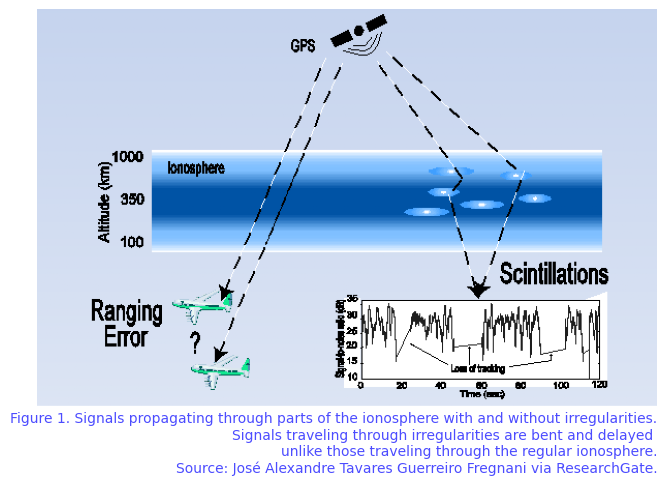
These irregularities introduce fluctuations in the signals. The term “scintillation” is commonly used to define these fluctuations, and can cause an airplane to stray from its original path of travel. Figure 1 shows signals propagating through parts of the ionosphere with and without irregularities. Signals traveling through irregularities are bent and delayed unlike those traveling through the regular ionosphere
For emphasis, scintillation is a rapid fluctuation in the amplitude (signal strength) and phase of radio signals as they pass through irregularities in the ionosphere, particularly in equatorial and polar regions.
Now, you know why an airplane must have these back-ups. In simple terms, it is because the the ionosphere, especially the equatorial ionosphere, can cause the satellite signals to fail.
The presence of these back-ups translate into economic factors. That is, the overall cost of an airplane will definitely be higher with all these back-ups included.
Hence, understanding the structure of these irregularities and the ionosphere makes it possible to model and predict their occurrence and thus build robust navigation systems.
From this example, do you now have an idea why we study this component of space; the ionosphere?
# This code was used to Load the image
img = mpimg.imread('/media/amadi/Amadi_new_drive/BRIANSPACE/BOMO/IMAGES/scint.png')

# Create figure and plot
plt.figure(figsize=(8, 6))
plt.imshow(img[0:600, 0:900])  # Crop area
plt.axis('off')

# Add text at the bottom right
plt.text(
    600, 450,
    (
        "Figure 1. Signals propagating through parts of the ionosphere "
        "with and without irregularities.\n"
        "Signals traveling through irregularities are bent and delayed \n"
        "unlike those traveling through the regular ionosphere.\n"
        "Source: José Alexandre Tavares Guerreiro Fregnani via ResearchGate."
    ),
    color='blue',
    fontsize=10,
    ha='right', va='bottom',
    backgroundcolor='white',
    alpha=0.7
)


plt.show()
And this, is the impact of the equatorial ionosphere on air travel. There are many more but for now, lets see what the equatorial ionosphere is, and how they cause these scintillations.